
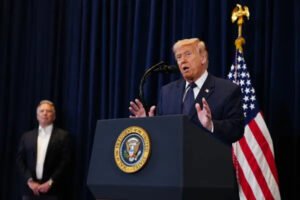
Amid escalating tensions involving the United States, Israel, and Iran, President Donald Trump has moved to reassure Americans that their safety remains a top priority—even as his rhetoric toward Tehran has grown increasingly forceful.
In recent remarks, Trump emphasized that while the global situation may appear volatile, the U.S. homeland remains secure under what he described as a carefully structured defense and intelligence system. His message has been clear: heightened tensions abroad do not translate into immediate danger at home.
Speaking in an interview with Politico on April 7, Trump described the unfolding situation as complex and rapidly evolving. He explained that developments in the region are being monitored continuously, with decisions reviewed around the clock. According to the president, this is not a short-term diplomatic issue but part of a broader geopolitical challenge requiring constant attention at the highest levels.
At the same time, Trump has not shied away from strong language. In a series of posts on Truth Social, he issued stark warnings directed at Iran, suggesting severe consequences if U.S. demands are not met. One particularly intense message drew widespread attention, with critics arguing that the tone risked escalating an already fragile situation.
However, Trump later clarified that his statements were intended as a strategy of deterrence rather than provocation. By projecting strength, he argued, the U.S. could pressure Iranian leadership into compliance and ultimately avoid further conflict. In his view, clear and direct messaging reduces the risk of miscalculation by outlining firm consequences.
A key flashpoint in the الأزمة remains the Strait of Hormuz, one of the world’s most critical oil transit routes. Any disruption in this narrow passage—through which a significant portion of global energy supplies flows—has immediate implications for international markets. Trump warned that restrictions in the strait could trigger serious economic consequences worldwide, including spikes in oil prices and supply instability.
According to his statements, the U.S. had pushed for the full reopening of the waterway by a specific deadline, warning that failure to comply could lead to targeted responses against key infrastructure. These remarks heightened global anxiety, particularly among energy analysts and investors closely watching the region.
Yet, despite the tough stance, there are signs of a more measured approach behind the scenes. Trump indicated that the administration is open to a temporary de-escalation, including the possibility of a short-term ceasefire. He suggested that a two-week pause in hostilities could be considered if immediate steps are taken to restore maritime access and reduce tensions.
This dual approach—combining pressure with conditional diplomacy—has defined the administration’s strategy so far. Trump described it as a way to maximize leverage while still leaving room for negotiation. He also revealed that Iranian officials had submitted a structured proposal outlining potential paths toward compromise, signaling that diplomatic channels remain active.
The stakes extend far beyond the region. Any prolonged disruption could impact global energy markets, trade routes, and political alliances. The relationship between the United States and its Middle Eastern allies, particularly Israel, adds another layer of complexity, while Iran’s regional influence continues to shape the broader الأزمة.
Despite criticism from some quarters, Trump has maintained that strong leadership and decisive communication are essential in preventing escalation. He insists that the ultimate goal is not conflict, but stability.
For now, his message to Americans remains consistent: while tensions may be rising overseas, the administration is focused on protection, preparedness, and avoiding a larger crisis. As diplomatic efforts continue, the coming days will be crucial in determining whether the situation moves toward resolution—or further confrontation.