
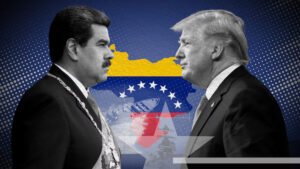
The dramatic detention of Venezuelan President Nicolás Maduro has ignited a global media storm—and with it, a wave of startling allegations spreading rapidly online.
As reports circulate that U.S. authorities have taken Maduro into custody to face long-standing criminal charges, an unverified claim has captured public attention: that former U.S. President Donald Trump and Maduro may have secretly reached a behind-the-scenes deal before the arrest.
According to the viral allegation, the capture of Maduro was not merely a law-enforcement operation, but part of a calculated political arrangement. The theory suggests that Maduro allegedly agreed to surrender or allow himself to be detained in exchange for future protection, including a presidential pardon for himself and his wife.
In return, the claim asserts, Maduro would provide explosive information accusing Venezuela of assisting U.S. Democrats in manipulating the 2020 presidential election.
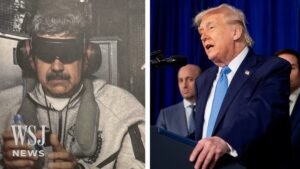
No evidence has been presented to support these assertions. Neither Trump nor his representatives have confirmed any such arrangement, and U.S. prosecutors have made no reference to election-related revelations in court filings or public statements. Election officials and intelligence agencies have repeatedly said there is no credible proof that foreign interference altered the outcome of the 2020 vote.
What is verified, however, is that Maduro has long been a target of U.S. law enforcement. For years, American authorities have accused him of overseeing drug trafficking networks and collaborating with armed groups designated as terrorist organizations. Those charges, first announced publicly in 2020, included a multimillion-dollar reward for information leading to his arrest. The latest developments appear to be a culmination of that effort, marking an extraordinary moment in U.S.–Latin American relations.
Maduro, for his part, has denied all allegations against him and has reportedly described his detention as illegal, arguing that he remains Venezuela’s legitimate head of state. His legal team is expected to challenge the jurisdiction of U.S. courts and raise questions of sovereign immunity—arguments that legal experts say face steep obstacles.
The alleged “secret deal” narrative has flourished largely on social media, where speculation often fills gaps left by limited official information. Analysts say the story’s appeal lies in its blend of real political tensions, Trump’s continued influence in U.S. politics, and widespread distrust of institutions on both sides of the ideological divide. “These claims thrive because they feel dramatic and consequential,” said one political analyst. “But so far, they remain unsupported.”
International reaction to Maduro’s detention has been swift and divided. Some governments have condemned the move as a violation of national sovereignty, while others see it as a significant step toward accountability for alleged crimes tied to narcotics trafficking and corruption.
As Maduro’s legal case moves forward, the focus will remain on the courtroom rather than the rumor mill. Until credible evidence emerges, claims of a clandestine Trump–Maduro deal remain speculative—an illustration of how moments of geopolitical shock can quickly give rise to narratives that blur the line between verified news and conjecture.