
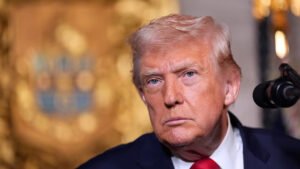
Donald Trump’s nationally televised address on Wednesday sparked widespread reaction, not only because of its political content but also due to the former president’s unusual delivery.
While Trump focused on familiar themes such as the economy, immigration, and criticism of previous administrations, many viewers said they were unsettled by his tone, pace, and overall demeanor. Now, a prominent medical expert has publicly voiced concern, describing the speech as alarming from a health perspective.
The address, which lasted roughly 20 minutes, quickly drew attention on social media. Viewers noted that Trump, who is typically known for a controlled and deliberate speaking style, appeared to shout into the camera and race through his remarks. His delivery struck some as unusually intense and pressured, prompting speculation about whether something more serious might be going on behind the scenes.
One of those raising red flags was Dr. Jonathan Reiner, a cardiologist and professor of medicine and surgery at George Washington University.
Writing on X shortly after the speech, Reiner said plainly, “I’m seriously concerned about the health of the president.” His comments quickly gained traction, adding fuel to the ongoing debate about Trump’s physical and mental fitness.
Reiner expanded on his concerns during an interview with CNN’s Jake Tapper on Thursday’s edition of The Lead. He stressed that his reaction had little to do with Trump’s political positions, which he described as “standard fare” for the former president. Instead, Reiner said it was the manner of delivery that he found troubling.
According to Reiner, Trump’s speech had what he described as a “manic” or “frantic” cadence. He compared listening to it to hearing a podcast played at double speed. “It was very pressurized speech,” Reiner said, adding that Trump appeared increasingly rushed as the address went on. “We’ve never seen the president like that before. He seemed almost uncontrolled.”
Reiner emphasized that such behavior is especially concerning given Trump’s role as commander-in-chief. “He’s not just the head of the government,” Reiner noted. “He’s the commander-in-chief of the greatest armed forces this world has ever seen. To see him appear almost frantic is disturbing.”
The comments come amid renewed scrutiny of Trump’s health more broadly. In recent months, the White House has faced questions about visible bruising on Trump’s hands and swelling around his ankles. While officials have offered explanations and reassurances, Reiner argued that the administration should be more transparent.
“I think the White House should be more forthcoming about the president’s health,” he said, noting that some of the signs seen publicly are “no one should be happy to see.”
Reiner also pointed to reports and footage suggesting that Trump has appeared to fall asleep during meetings, including in the Oval Office and at cabinet gatherings. He described this as “increased daytime somnolence,” a condition that can be linked to several underlying issues.
“One common cause is sleep apnea,” Reiner explained, a disorder that disrupts sleep and prevents restorative rest. Sleep apnea is often treated with devices such as CPAP machines, but Reiner noted that the public has never been informed that Trump has been diagnosed with the condition.
What Reiner found most striking was the contrast between Trump appearing drowsy in meetings and then delivering a rapid-fire speech in a significantly shorter time than expected. “It’s jarring,” he said, adding that the shift raises legitimate questions that deserve clearer answers.
While Trump’s supporters dismiss the criticism as political or exaggerated, the expert commentary has reignited a broader discussion about transparency, health, and the demands placed on those holding the nation’s highest office.